
 Craig Alexander - Soul Revival
 All Stars - Older Slower Softer
 Peter Baartmans, George Fleury - Yamaha Electone. Mehr Als Eine Orgel. Yamaha 1887-1987
 Duke Dumont - Won't Look Back
 George Formby - Formby Favourites
 Shout Out Louds - Tonight I Have To Leave It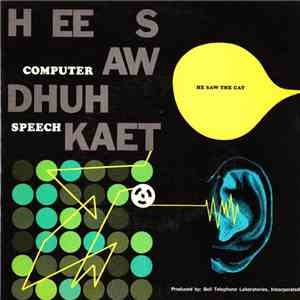
Title:
Bell Telephone Laboratories, Inc. - Computer Speech - Hee Saw Dhuh Kaet (He Saw The Cat) download free
Performer:
Bell Telephone Laboratories, Inc.
Album:
Computer Speech - Hee Saw Dhuh Kaet (He Saw The Cat)
Country:
Released:
Genre:
Style:
Education, Spoken Word, Experimental, Musique Concrète
MP3 archive size:
1964 mb
FLAC archive size:
1361 mb
WMA archive size:
1102 mb
Other formats:
APE VOX DXD AHX AIFF WAV VOC
Rating:
4.3
Votes:
705
Download links
Tracklist
| A1 | Greetings |
| A2 | Basic Examples |
| A3 | An Historic Remark |
| A4 | "Hamlet" Soliloquy |
| A5 | Bicycle Built For Two (Unaccompanied) |
| A6 | Bicycle Built For Two (Accompanied) |
| A7 | Computer Duplicate Human Voice |
| A8 | Goodbye |
Credits
- Producer, Liner Notes – D.H. VanLenten
- Written-By – D.H. VanLenten
Notes
From the album liner notes written by D.H. VanLenten:"This recording contains samples of synthesized speech - speech artificially constructed from the basic building blocks of the English language. A machine which produces synthesized speech is called, fittingly, a talking machine. There are many possible kinds of speech synthesizers or talking machines. Instead of building and testing a variety of them, scientists at Bell Telephone Laboratories simulate their behaviour with a high-speed, general purpose computer. The computer is instructed (programmed) to accept in sequence on punched cards the names of the speech sounds which make up an English sentence. It then processes this information, in accordance with the linguistic rules governing the English language, and produces an output analogous to the output of the talking machine it is programmed to simulate. The talking machine simulated by the computer in this recording would normally be operated by continuously feeding it a set of nine control signals. The signals correspond to voice pitch, voice loudness, lip opening and other speech variables. When every instant of sound is specified, and every variable accounted for, such a machine produces human-sounding speech.
Setting up the computer to simulate this talking machine requires two sets of instructions or, more precisely, a two-part computer program. One part of the computer program performs the actual sound making function - it imitates the "talking' of a talking machine. The second part consists of rules for combining individual speech sounds into connected speech, and for producing the nine control signals that activate the talking machine. Scientists at Bell Telephone Laboratories have developed a computer program that permits them to feed the names of speech sounds into the computer on punched cards. They also have devised a phonetic code using the letters of the alphabet. At present, it is made up of 22 consonant and 12 vowel sounds:
CONSONANTS: P - B - T - D - K - G - M - N - NG (as in sing) - F - V - S - Z - SH (as in she) - ZH (as in azure) - H - W - R - L - Y - TH (as in thin) - DH (as in then)
VOWELS: EE (as in bee) - I (as in ill) - AY (as in rate) - E (as in end) - AE (as in add) - AH (as in ah) - AW (as in jaw) - (as in go) - OO (as in foot) - UU (as in food) - UH (as in up) - ER (as in her)
Each speech sound is specified on a separate punched card. When a sequence of cards is fed into the computer, it "operates' on the information - following the rules set up in the second part of its program - to produce the nine control signals that activate the talking machine program. For example, if the sequence of cards, H - EE - S - AW - DH - UH - K - AE - T, is fed into the computer, the machine will say "He saw the cat,' in flat monotones. Proper inflection and phrasing are achieved by specifying on each card the changes in pitch and timing natural to human speech.
By specifying the pitch of the sounds, it also is possible to make the computer sing. In two of the samples recorded, the computer first sings a familiar tune and then, singing the same song, is accompanied by music played by another computer. The "speech' of the simulated talking machine comes out of the computer as tiny magnetized spots on half-inch magnetic tape. The tape is fed to another machine which converts the spots to a sound tape suitable for playing on an ordinary tape recorder.
The first eight and very last samples of synthesized speech on this recording are part of a research program aimed, principally, at formulating a minimum set of rules for making plausible English speech. The ninth and tenth selections were produced by analyzing a person's speech and re-constructing it synthetically on a computer. The objective of this program is to duplicate the sounds and transitions made by a human speaker, including his accent and dialect.
Knowledge developed through such research programs may be useful in devising new techniques for transmitting speech more efficiently over communications systems. In the near future, for example, a person may be able to type on a keyboard and cause a typing machine thousands of miles away to speak for him. There is also the possibility that talking machines may be built for people who are unable to speak."
Barcode and Other Identifiers
- Matrix / Runout: PB - 287 - N3
- Matrix / Runout: MP 10000
Other versions
| Category | Artist | Title (Format) | Label | Category | Country | Year |
|---|---|---|---|---|---|---|
| PB-187 | Bell Telephone Laboratories, Inc. | Computer Speech (7") | Bell Telephone Laboratories, Inc. | PB-187 | US | 1963 |
| MG-3085 | Bell Telephone Laboratories, Inc. | Langage D'Un Ordinateur - Hee Saw Dhuh Kaet (He Saw The Cat) (7", S/Sided, Ltd) | Bell Telephone Laboratories, Inc. | MG-3085 | Canada | 1963 |
Related Bell Telephone Laboratories, Inc. - Computer Speech - Hee Saw Dhuh Kaet (He Saw The Cat) albums
 Kraftwerk - Computer World download
 William Bell & Janice Bulluck - I Don't Want To Wake Up (Feelin' Guilty) / Whatever You Want (You Got It) download
 Josh - Was A Sunny Day download
 Larry Austin - CDCM Computer Music Series Vol. 28: The Composer In The Computer Age VIII download
 Bernstein, New York Philharmonic - Beethoven: Fifth Symphony download
 Free Cake For Every Creature - Talking Quietly of Anything With You download
 Jovan Janićijević - Novogodišnje Želje download
 Allemansrätten - Guldkåken download
 EV3 - Human Machine download
 Gene Seahorn - Never Seen A Building As Pretty (As A Tree) download

 Lady Ann, Keeling Beckford - Loving Stylee
 Jin + Quortoth - Zaporo EP
 Lionel Richie - Live
 Moon / Intra Tenebrae / Mystified - Magick Rituals I: The Magick Seal
 Japery - Crabmeat Beats
 Bicep - Bicep
 AFX - Analogue Bubblebath 4
 Round One - I'm Your Brother
 Clint Mansell Performed By Kronos Quartet & Mogwai - The Fountain (Original Motion Picture Soundtrack)
 Donna Summer - Donna Summer
 Arthur Russell - In The Light Of The Miracle
 John Digweed - Live In Miami 1/5
 Son Lux - Bones